What is the Cost of Opening an E-commerce Website and Why is it Important?
In today's digital age, an online presence has become indispensable for businesses to gain a competitive advantage and reach wider audiences. E-commerce, in particular, offers the opportunity to break through physical boundaries and access global markets. However, for many entrepreneurs and SMEs looking to leverage this potential, one of the first questions that comes to mind is "what will be the e-commerce website opening cost?" This cost is not a single fixed figure; rather, it's a structure that varies depending on many factors, and a detailed understanding of all cost items is crucial for accurate budget planning.
The e-commerce website opening cost encompasses not only initial setup expenses but also the ongoing costs required to ensure the site operates smoothly in the long term. These expenses range from the chosen e-commerce platform to site design, from hosting services to security measures, and from product entry to marketing activities. An e-commerce venture started without a proper cost analysis risks encountering unexpected expenses and jeopardizing the project's sustainability. Therefore, creating a transparent and realistic budget is the first step towards achieving success in e-commerce.
Initial Costs: First Investment Items
The first and most significant expenditure you'll encounter when setting up an e-commerce website is the initial costs. These costs cover the fundamental elements of your site, and making the right choices can significantly lighten your future operational load. Here are the primary initial cost items:
E-commerce Platform (Software) Selection: This is one of the biggest determinants of cost. Ready-made e-commerce packages generally offer more affordable initial costs and enable quick setup, often coming with monthly or annual subscription models. Custom software development, on the other hand, can have much higher initial costs as it's tailored entirely to your business needs, but it offers greater flexibility in the long run.
Domain Name and Hosting: Your domain name (e.g., companyname.com), which is your business's online identity, is an annually renewable cost. Hosting is the server service where your site's files are stored. Choosing a quality hosting service is critical for e-commerce sites due to their high traffic and security needs. These expenses are typically paid annually.
SSL Certificate: An SSL certificate is mandatory to ensure the security of customer data (credit card information, personal data). This certificate, which provides the "secure" label in browsers, is important for both user trust and search engine rankings. It usually requires annual payment.
Design and Theme Development: Your site's visual identity is vital for user experience. Ready-made themes are more cost-effective, while custom design and user interface (UI/UX) developments can lead to much higher costs. A mobile-responsive and user-friendly design that reflects your brand's identity will directly impact your conversion rates.
Product Entry and Content Creation: Taking professional photos of the products you will sell, writing product descriptions, and creating category and brand pages is a time-consuming and labor-intensive process. You can do this yourself or incur a cost by getting professional support.
Legal Processes and Consulting: Understanding legal regulations for e-commerce (GDPR equivalent, distance selling agreements, etc.) or obtaining professional legal advice can also be included in initial costs.
Ongoing Costs: Sustaining Your Business
Setting up your e-commerce website is just the first step. Maintaining a successful online store also brings recurring costs that take up a significant portion of your budget. Managing these cost items correctly is critical for your business's long-term profitability.
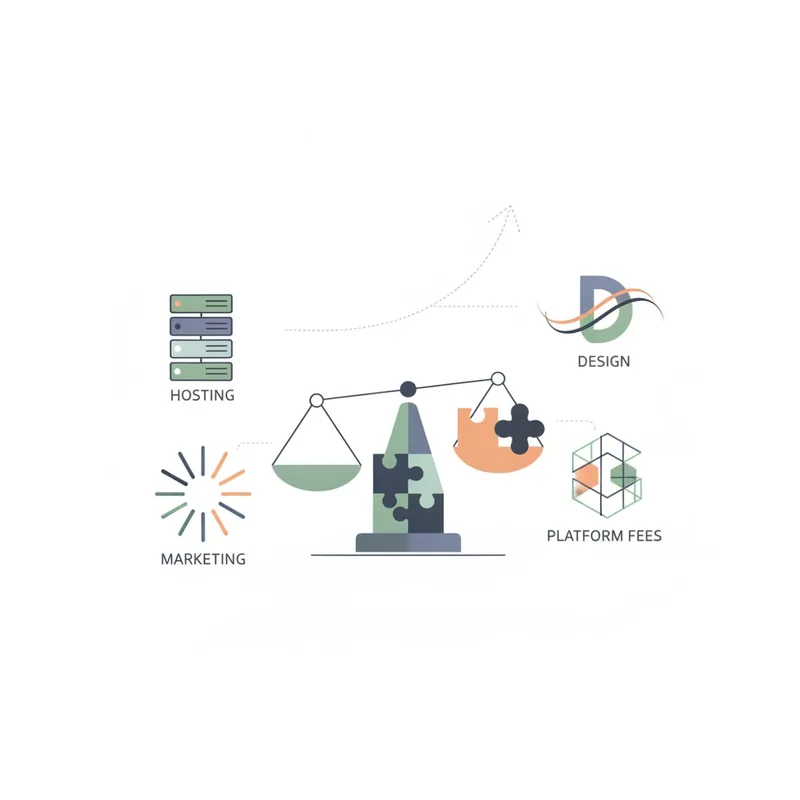
The combination of different items that make up the cost of opening an e-commerce site.
Software/Infrastructure License or Subscription Fees: Depending on the e-commerce platform you choose, you will need to pay monthly or annual subscription fees. These fees typically vary according to the features, storage space, bandwidth, and support level offered by the platform. Access to updates and new features is also usually included in these subscriptions.
Maintenance, Updates, and Technical Support: Regular maintenance and updates are essential for your e-commerce site to run smoothly, address security vulnerabilities, and optimize performance. It's also important to receive fast and effective support when you encounter technical issues. These services are often provided by your platform provider or can be purchased as an additional service.
Payment System Commissions: To accept payments from your customers via credit card or other online payment methods, you will need to use virtual POS or payment gateway services. These service providers charge a certain percentage commission or a fixed transaction fee for each transaction. As your sales volume increases, these commissions can become a significant expense.
Shipping and Logistics Costs: You will need to contract with shipping companies to deliver your products to your customers. Shipping fees vary depending on the product's weight, dimensions, shipping distance, and your agreement terms. Warehousing, packaging, and return logistics can also be included in this category.
Marketing and Advertising Expenses: Marketing activities are indispensable for driving traffic to your e-commerce site and increasing sales. You will need to allocate a regular budget for items such as search engine optimization (SEO), social media marketing, email marketing, Google Ads, and social media advertisements. These investments increase your brand awareness and help you reach potential customers.
Personnel Expenses: You may need a team to manage operational processes such as order management, customer service, product updates, and marketing strategies. As your business volume grows, personnel expenses in this area will also increase.
The Impact of E-commerce Platform Choice on Cost and Success
One of the most significant factors influencing your e-commerce site's setup cost and long-term success is choosing the right e-commerce platform. Various platforms are available in the market, suitable for different needs and budgets. These platforms can generally be divided into two main categories: ready-made e-commerce packages and custom software solutions.
Ready-Made E-commerce Packages: These solutions are typically subscription-based and ideal for businesses that want to open an online store quickly and easily. Setup costs are low, technical knowledge requirements are minimal, and hosting, security (SSL), and basic features are usually included in the package. Our our e-commerce software solution at Uniesoft provides a user-friendly and secure infrastructure that enables businesses to rapidly digitize. These packages offer significant advantages in terms of cost-effectiveness and operational ease, especially for SMEs and startups. They cover all basic needs such as product and category management, payment system integration, shipping options, mobile-responsive design, and a fundamental SEO-friendly infrastructure.
Custom Software Solutions: These are software solutions developed from scratch specifically for a business. Initial costs are much higher, and the development process is longer. However, they offer the flexibility to perfectly align with your business's unique processes and very specific needs. They may be preferred for large-scale businesses with highly complex operations, but maintenance and update costs are also generally higher.
At Uniesoft, we provide scalable and reliable e-commerce infrastructures that align with businesses' growth objectives. Our e-commerce packages are designed to meet the needs of businesses of various sizes. By combining cost-effectiveness, ease of use, and robust performance, we ensure your business remains competitive in the digital market. Choosing the right platform directly impacts not only your initial costs but also your operational efficiency, customer satisfaction, and long-term profitability. Therefore, when making your choice, it is critically important to consider your current needs, future growth potential, and target audience.
Key initial investment items you will encounter when setting up your your e-commerce site.
Hidden Costs and What to Watch Out For
When calculating the e-commerce website opening cost, some "hidden" costs often overlooked or underestimated initially can emerge. These costs can strain your budget and prevent your project from progressing as planned. Therefore, it would be wise to account for these potential expenses from the outset.
Integration Costs: You might want to integrate your e-commerce site with your existing business processes (e.g., accounting software or inventory tracking). These integrations often require additional software development or plugin costs. Starting with a simple structure and gradually adding integrations as your business volume grows can be a good strategy to manage costs.
Data Security and Backup: Cyber security threats are increasing daily. To protect customer data, ensure legal compliance, and guarantee business continuity, budgeting for additional security measures (firewall, DDoS protection) and regular data backup solutions may be necessary. This should generally be viewed like an insurance premium.
Training Costs: Training may be required for you and your team when starting to use a new e-commerce platform. Investing in these trainings to effectively use the platform's features, and to increase efficiency in processes such as product management, order tracking, and customer service, will save you time and reduce error costs in the long run.
Return and Exchange Process Management: Returns and exchanges are inevitable in e-commerce. Managing these processes (shipping costs, product inspection, stock updates, customer communication) can create a significant operational burden and cost item. Establishing an effective return policy and infrastructure helps control costs while increasing customer satisfaction.
Legal Compliance and Updates: E-commerce laws and regulations (such as consumer rights, GDPR equivalents) can be updated from time to time. Legal consultation or software updates may be required to ensure your site's compliance with these current laws. This can become even more complex for businesses planning international sales.
Optimizing Costs and Smart Budget Planning
Although the e-commerce website opening cost might seem high, it's possible to optimize these costs and plan your budget smartly with the right strategies. Here are some methods you can apply to reduce costs and maximize your return on investment (ROI):
Conduct a Needs Analysis: Initially, focus on "must-have" features rather than all "nice-to-have" ones. By starting with a minimum viable product (MVP) approach, you can add extra features and integrations as your business grows. This will significantly reduce initial costs.
Choose Scalable Solutions: Ensure that your chosen e-commerce platform has the potential to grow with your business. Avoid solutions that seem affordable initially but might restrict you later or incur high upgrade costs. Flexible and scalable platforms like Uniesoft will provide you with a cost advantage in the long run.
Utilize Your Own Resources: Especially in areas like content creation (product photos, descriptions) and social media management, using your own resources initially can reduce costs compared to outsourcing. However, be careful not to compromise on professional quality.
Manage Your Marketing Budget Smartly: Digital marketing is a broad field. Initially, focus on the channels that will bring the highest conversion. For example, if your products appeal to a niche audience, investing in targeted social media ads or SEO might be more efficient than general advertising. Prefer performance-based advertising models.
Think Long-Term: Instead of looking for the cheapest solution, invest in solutions that will add value in the long run and provide operational efficiency. A quality infrastructure, good user experience, and robust security will prevent future problems and additional costs.
Don't Hesitate to Seek Professional Support: Especially for critical issues like platform selection, security settings, and SEO optimization, getting expert support can prevent missteps and lead to long-term cost savings.
The e-commerce website opening cost is a manageable process with proper planning and strategic choices. At Uniesoft, we stand by you on this journey by offering cost-effective and scalable e-commerce solutions tailored to your business needs. If you are looking for professional support to establish a strong presence in the digital world and increase your sales, you can contact Uniesoft's expert team to discover the most suitable solutions for your business. Take the first step towards a successful e-commerce future today!
Enter your contact information for all the questions you are curious about, and our expert team will help you as soon as possible!
Size daha iyi hizmet sunmak için çerezler ve benzeri teknolojilerle ziyaret verilerinizi işliyoruz.
Analitik ve pazarlama çerezleri yalnızca onayınızla çalışır.
Detaylar için KVKK Aydınlatma Metni.






 English
 Türkçe